Welding Helmet vs. Handheld Mask: A Complete Guide
Welding is a craft where precision and safety are not just goals, but absolute necessities. The intense ultraviolet (UV) and infrared (IR) radiation from a welding arc can cause severe and permanent eye damage, a condition known as arc flash. Protecting your eyes and face is the first rule of welding, and the two most common tools for this job are the traditional handheld mask and the modern auto-darkening helmet. While both offer protection, they represent vastly different approaches to workflow, efficiency, and overall safety. This guide provides a definitive showdown, breaking down their core differences to help you understand why one is a professional standard and the other is a situational tool.
Understanding the Contenders: Two Philosophies of Welding Protection
At first glance, a handheld mask and a welding helmet serve the same purpose. However, their design and operational principles are fundamentally different, impacting everything from the quality of your weld to your personal safety.
The Traditional Handheld Welding Mask
The handheld welding mask, or shield, is the classic, original form of welding protection. It is essentially a simple screen with a handle and a fixed, dark-tinted lens (typically a #10 shade). The operator holds the mask in one hand to cover their face while using the other hand to weld. Its core philosophy is simplicity and portability. Made from lightweight materials like vulcanized fibre or polypropylene, it’s easy to carry and use for very brief tasks, like a single tack weld. However, this simplicity comes at a significant cost to efficiency and safety, as one hand is always occupied.
The Modern Auto-Darkening Welding Helmet
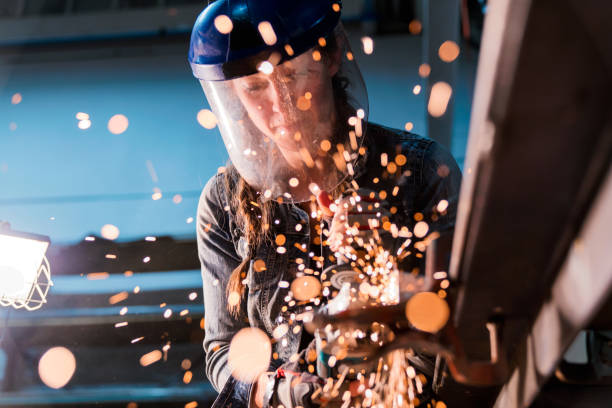
The auto-darkening helmet is a technological leap forward. Worn on the head, it leaves both hands free. Its key feature is the Auto-Darkening Filter (ADF), a sophisticated electronic lens that remains transparent (around a #3 or #4 shade) until it detects the bright light of a welding arc. In a fraction of a second (often 1/25,000th or faster), it instantly darkens to a pre-selected welding shade (#9-#13). This allows the welder to see their workpiece clearly before starting, position the torch or electrode with precision, and then have instant protection the moment the arc is struck. This hands-free, automated protection is the cornerstone of modern welding efficiency and safety.
Head-to-Head Comparison: Key Performance Metrics
When choosing between these two options, several critical factors come into play. While the handheld mask might seem viable for tight spaces, a detailed comparison reveals a clear winner for nearly every professional and hobbyist application.
| Feature | Handheld Welding Mask | Auto-Darkening Helmet |
|---|---|---|
| Hands-Free Operation | No. Requires one hand to hold, severely limiting work stabilization and material handling. | Yes. Frees both hands for welding, fitting, and bracing the workpiece. |
| Efficiency & Workflow | Low. Constant need to lift and lower the mask disrupts workflow and slows down the process. | High. Seamless transition from setup to welding without moving the helmet, increasing productivity. |
| Weld Start Accuracy | Poor. The “nod” technique (positioning and then nodding to drop the helmet) is not possible. You must position the mask and then the torch, often blindly. | Excellent. The clear lens allows for precise positioning of the electrode or wire before striking the arc, preventing misfires. |
| Safety & Protection | Adequate but inconsistent. Risk of accidental arc flash during positioning. Offers less coverage for the neck and sides of the head. | Superior. Full head and neck coverage from sparks and spatter. The ADF provides constant UV/IR protection, even in its light state. |
| Versatility | Limited. Best for quick tacks or inspection. Very difficult for complex or out-of-position welds. | High. Suitable for all types of welding (MIG, TIG, Stick) and positions. Adjustable shades accommodate different amperages. |
| Ergonomics | Poor. Causes arm fatigue during prolonged use. Awkward to use in many positions. | Good. Modern helmets feature adjustable, padded headgear for all-day comfort. |
The Verdict: Why a Welding Helmet is a Non-Negotiable Investment
The conclusion is clear: for any serious welding, an auto-darkening helmet is not a luxury but an essential piece of equipment. The source article’s scenario of welding in a tight space under a car perfectly illustrates this. While a handheld mask might physically fit, the act of holding it while trying to weld in an awkward position is inefficient and dangerous. A modern helmet provides hands-free protection, allowing the welder to use their other hand to stabilize themselves or the torch, leading to a better, safer weld.
The primary benefit of a helmet is the elimination of “arc flash” risk that comes from improper mask positioning. The continuous workflow it enables—seeing your work, welding, and inspecting the slag without ever removing your protection—translates directly into higher quality welds and significantly increased productivity. The initial cost of a quality helmet is quickly offset by faster work and fewer mistakes.
Expert Advice: Selecting and Maintaining Your Welding Helmet
Choosing the right helmet is crucial. Not all auto-darkening helmets are created equal. Here are some professional tips for selecting a helmet that will serve you well.
Technical Checklist for a Quality Helmet
- Optical Clarity: Look for a rating like 1/1/1/1 or 1/1/1/2. This standard rates the lens on clarity, diffusion, and angular dependence. A 1/1/1/1 rating is the highest and provides the clearest, most distortion-free view.
- Reaction Time: This is how quickly the lens switches from light to dark. A professional-grade helmet should have a reaction time of 1/20,000 of a second or faster to prevent eye fatigue.
- Number of Arc Sensors: Most helmets have two to four sensors. Four sensors are ideal, especially for out-of-position or low-amperage TIG welding, as they reduce the chance of the lens being blocked and failing to darken.
- Viewing Area Size: A larger viewing area provides a better field of view, which can increase comfort and awareness. However, this can also increase the helmet’s weight.
- Adjustable Shade, Sensitivity, and Delay: A variable shade range (e.g., 9-13) is essential for different processes. Sensitivity control adjusts how much light triggers the lens, while delay control sets how long the lens stays dark after the arc stops.
- Comfortable Headgear: You will be wearing this for hours. Look for multiple adjustment points, a padded headband, and a balanced design to reduce neck strain.
Frequently Asked Questions (FAQ)
- Can a handheld mask provide enough protection for professional welding?
- While the lens in a handheld mask can block harmful rays during the weld, the device itself is not recommended for professional use. The one-handed operation is inefficient, increases the risk of poor-quality welds, and leaves the user vulnerable to accidental arc flash when positioning their work. It does not offer the full coverage or consistent safety of a helmet.
- What is “arc flash” and how do helmets prevent it better?
- Arc flash, or “welder’s flash,” is a painful inflammation of the cornea caused by exposure to intense UV radiation from the welding arc. It feels like having sand in your eyes. Auto-darkening helmets prevent this by darkening automatically and providing constant UV/IR protection. With a handheld mask, a user might accidentally strike an arc before the mask is in position, causing an instantaneous flash.
- Are expensive auto-darkening helmets worth the money?
- Generally, yes. Higher-priced helmets typically offer better optical clarity, more sensors, faster reaction times, and more comfortable, durable headgear. For a professional welder or serious hobbyist, the investment in a high-quality helmet pays off in comfort, safety, and the quality of their work.
- How do I know what shade number to use for my welding?
- The correct shade depends on the welding process and amperage. As a general rule: Stick welding often uses shades 10-14, MIG welding uses 10-13, and TIG welding can range from 8-14 depending on the amperage. Always consult the manufacturer’s chart or OSHA guidelines for specific recommendations. A helmet with a variable shade range provides the flexibility to handle all these processes.
- Can I use a welding helmet for grinding?
- Many modern auto-darkening helmets feature a “grind mode.” This mode deactivates the auto-darkening sensors, keeping the lens in its light state (usually shade 3 or 4) so you can see clearly while grinding. This allows you to switch from welding to grinding without changing your face protection, which is a major convenience and safety feature.
Technical and safety note: This article is for general editorial information only. Welding, electrical, respiratory, home repair, grooming, child-safety, material-science, and building topics should be checked against current standards, manufacturer instructions, local codes, and qualified professionals before use.
- The Ultimate Lifecycle Management Guide for Auto-Darkening Welding Helmets
- Nylon vs. Polycarbonate Welding Helmets: A Comprehensive Material Showdown