The Nakagin Capsule Tower: Timeless Architectural Beauty
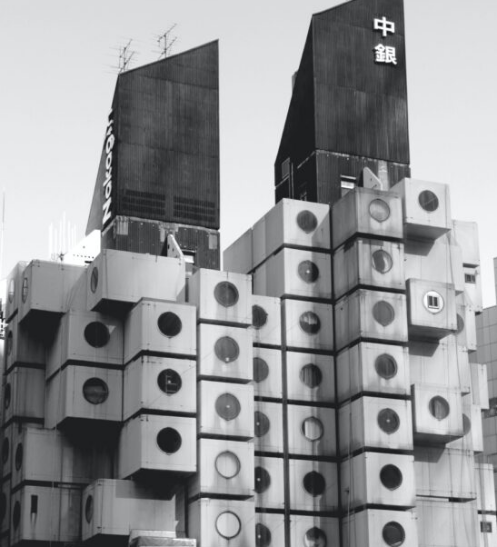
Standing out on Tokyo’s skyline, the Nakagin Capsule Tower, locally known as “中銀カプセルタワー,” captivates with its unique design. Designed by Kisho Kurokawa, it embodies the futuristic ideals of Japan’s post-war Metabolist movement. As a leading figure of Metabolism, Kurokawa created this iconic structure with a forward-looking design perspective.
- Built in 1972, the project’s design philosophy far surpassed its era, incorporating concepts of adaptive architecture and flexible interior design. To this day, it remains a symbol of futurism and innovation, having withstood the test of time while preserving its distinct aesthetic.
- The Nakagin Capsule Tower is a masterpiece of Japan’s Metabolist movement and an iconic landmark in Tokyo’s Shinbashi district. However, the building now faces demolition and may soon vanish.
What Has Led to the Decline of This Timeless Beauty?
The Nakagin Capsule Tower and Its Heydays
Architecture critic Nicolai Ouroussoff views the Nakagin Capsule Tower as a reflection of cultural ideals, reminding people of untaken paths and demonstrating the possibilities of worlds under different value systems. The tower’s design integrates futurism, sustainability, and recyclability, created by Kisho Kurokawa and the Japan Urban Design Group. Its flexible and iconic interior design introduced new possibilities for the “plug-and-play” architectural concept.
All About Capsule Architecture
The building adopts a podium-and-tower design, embodying modernist style. The two towers of the Nakagin Capsule Tower have 11 and 13 stories respectively, and have been eye-catching since their completion. For architect Kisho Kurokawa, this was not only a project to showcase Japan’s strength and resilience but also an opportunity to promote the new capsule architecture style.
Key design features of the Nakagin Capsule Tower include sustainability and recyclability, with a central shaft capable of accommodating up to 140 self-contained capsules. Each capsule is equipped with adaptive custom interior fixtures and facilities, and can be flexibly connected to or detached from the central shaft. The orientation and layout of these capsules can be adjusted, or even combined into customized configurations.
The main goal was to create a sustainable facility for professionals who frequently move between cities, making it also ideal for those seeking affordable options in central Tokyo. The highlight of the project lies in its conceptualization process. Exterior features such as asbestos-clad walls and circular windows add a minimalist touch to the building’s appearance, while the edges of each unit bring a sense of playfulness to the facade.
Iconic Identity
The construction of the Nakagin Capsule Tower brought honor to both Japan and architect Kisho Kurokawa, becoming closely intertwined with their legacies. The design was a collaborative effort of experts from multiple fields. Kurokawa’s unique vision portrayed the city as dynamic and innovative, making the tower a symbol of the “new Japan” that connected the modern aspirations of the public with national visions. Capsule architecture holds significant meaning in pop culture, becoming an iconic reference in architectural literature, a popular photography spot, and appearing in Hollywood films and related literary works.

The Uncertain Future of the Nakagin Capsule Tower
The future of the Nakagin Capsule Tower hinges on the opposition between preservation and development. Despite once being a symbol of modern Japanese architecture, owners are considering demolishing it for land revenue. The building may soon be torn down to make way for new constructions, as it is privately owned and the government cannot intervene. This represents the decline of a structure that once symbolized national ideology.
The Abandonment of the Nakagin Capsule Tower
Owners have abandoned the building, leaving the unmanaged capsules to their own devices. They complain about insufficient space and heating/air conditioning issues caused by the asbestos exterior. Kurokawa’s expansion plans were never implemented, and reconfiguring the capsules is costly. Owners believe demolition and reconstruction are more economical.
In any case, the end of the Nakagin Capsule Tower seems imminent, and its bond with Kisho Kurokawa appears fragile. Whose failure is this? Is it the social and political stakeholders whose priorities have changed with the times? Or is it the architecture itself, which failed to consider economic factors in its design?
Influence
Why is the future of Tokyo’s Nakagin Capsule Tower so important? The general public obviously won’t sacrifice their self-interests for “art,” right? Yet we are not talking about an ordinary building. The Nakagin Capsule Tower is an architectural heritage. Its demolition is indeed a concern for global architecture enthusiasts. The building has always been a symbol of Japanese ideology, helping Japan establish its position on the global stage. It is also a pioneering work by Japan’s Metabolist pioneers.
If we allow the Nakagin Capsule Tower to be demolished, it will be a failure for all of us. Isn’t it the government’s responsibility to protect these important buildings that mark historical events? Without attention, the future of heritage architecture will suffer, meaning the devaluation of iconic art and architecture. Demolishing the Nakagin Capsule Tower will also lead to the demise of ideology, art, and history. If relevant parties in Tokyo or Japan cannot find a better path for its future, soon every architectural marvel will face similar threats.
A Ray of Hope
To improve the dilapidated state of the Nakagin Capsule Tower, relevant parties must recognize its significance and take action. Despite being abandoned, the tower still attracts many tourists and architecture enthusiasts. Protecting and developing it as an architectural tourist attraction could boost the government’s economy while considering the interests of private investors. Social and political intervention is needed to balance heritage preservation with owners’ needs. If authorities continue to take no stance, it will inevitably have a negative impact on the building’s future. Architecture has always been part of our social and cultural development, and failing to acknowledge the importance and status of heritage works is deeply demeaning.