The Rolling Design House at the Louvre-Lens
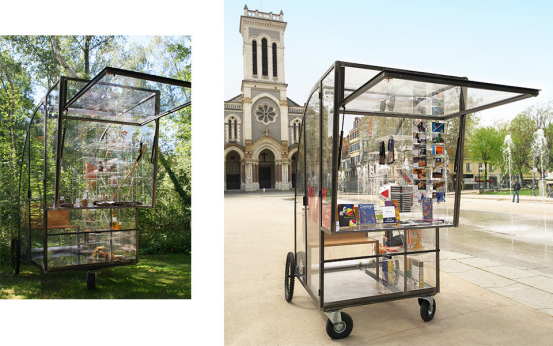
Architects are not always as expected. When the Louvre-Lens bought a work from an architect, does that mean the architect is an artist? This is not about SANAA, the firm that designed the museum, but about the “Rolling Design House” designed by the architectural design agency METEK.
On October 7, 2020, the Louvre Design Exhibition (on display until February 1, 2021) opened in the Glass Pavilion of the Louvre-Lens (Pas-de-Calais), a large glass space at the end of the Time Gallery wing. The exhibition aims to celebrate design and its origins, showcasing treasures from the Louvre (from ancient times to 1850), selected works of design concepts (from 1850 to the present), iconic works, and great figures in design history.
The brochure states: “Contrary to popular belief, design is not only about furniture or decoration but also about activities in all fields, capable of addressing economic, social, and environmental challenges.” In fact, METEK’s “Rolling Design House” (co-designed by Sarah Bitter and Christophe Demantké) fully meets these requirements.
The last time we wrote about METEK was in December 2017, when a project containing 31 social housing units and 7 artist studios on Rue Crimée in the 19th arrondissement of Paris was delivered. Sarah Bitter, co-founder of Metek in 2001, still regards architecture as an overall thinking and practice in an era dominated by economic needs, with photography, dance, and film all being part of its architectural practice.
Later, we briefly mentioned the “Rolling Design House”, which won an award at the 2019 Saint-Étienne International Design Biennale. As defined by Sarah Bitter, it is a multifunctional installation, a collection of various functions such as a circular display cabinet, office, desk, and bookstore, small but rich in functions.
In fact, the “Rolling Design House” responds to the questions of urban architects: what kind of design space can be imagined in public spaces, how to make biennale activities mobile, meet more audiences in cities, streets, museums, and accompany the flow of ideas in a walking manner, which is a unique journey of design imagination.
The project originated earlier than the Saint-Étienne Biennale, and a series of coincidences stimulated creativity. After the completion of the Crimée Street apartments, Sarah Bitter commissioned Céline Houdart to write an article about the project. “Villa Crimée” became a literary work composed of 212 fragments and achieved success. Subsequently, Céline Houdart held a writing residency at Mac Val from October 2017 to April 2018. After the residency, she wanted to invite friends to present new works. Metek presented the first version of “Rolling” in the form of an animated film, aiming to “welcome resident writers and promote writing workshops in the city”. Sarah Bitter once imagined a greenhouse with wheels, developed it for New York and named it “Rolling Greenhouse”, but the concept had changed significantly when the Saint-Étienne competition started. She lamented, “A mobile pavilion, I haven’t measured its difficulty.”
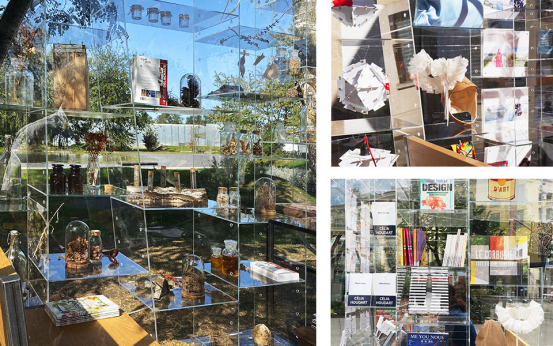
There were also various encounters, from theater costume designers to welders who built prototypes, including sponsors, and a tenacious determination. The “Rolling Design House” was placed on the biennale venue, integrated into the environment, attracted people’s curiosity, occupied different positions, and perfectly fulfilled its mobile role of communicating with the public.
Undoubtedly, this is why Marie Lavandier, director of the Louvre-Lens, was interested in this cultural intermediary, whose transparent design may echo the architectural style of the SANAA building. The museum has a spacious and beautiful park, open to the public, and is loved by regular visitors and local residents. However, for local residents who are more familiar with the architectural style of the nearby Stade Bollaert (their proud “Saint and Gold” stadium), the Louvre-Lens may be intimidating. How can we invite them to enter this museum which also has a covered picnic area?
Marie Lavandier and her cultural mediation team are committed to bringing the public into the museum. The Louvre thus obtained the exhibition of the “Rolling Design House”. Marie Lavandier has been displaying it in different locations of the Louvre-Lens since this summer to encourage encounters. “This is an easy-to-use form of mediation, and we are exploring new ways to use it,” said Gautier Verbeke, director of mediation services at the Louvre-Lens, happily. In fact, during the visit of the Chronicle, although the “Rolling Design House” was stored waiting for its next destination, it still attracted many curious visitors.
The “Rolling Design House” was moved to the entrance of the Louvre Design Exhibition, acting as a new medium and reception role inside, serving different visiting groups. Sarah Bitter emphasized that it is a dynamic object between art and industry. She discovered physical dynamics issues in Saint-Étienne and believed that this concept is worthy of development because it conforms to policies for the public. To build prototype 2 and envision mass production, she found a design office composed of former engineers from the Renault Guyancourt factory.
The architect said that a feasibility study was conducted to determine whether the “Rolling Design House” can be placed in public places, which also let people know that the regulations for towable objects stipulate a maximum width of 2 meters and unlimited length. Sarah Bitter said that certification can be started, then solve a number of technical problems, such as the trailer braking system, size or wind resistance issues, and how to make it a retractable object. Nevertheless, she envisions many functions for the “Rolling Design House”. During the pandemic, it can become a restaurant terrace bubble house or sell tickets at the entrance of a railway station. At the same time, like the Crimée Street housing project, she knows how to let the project complete a long journey.
Technical and safety note: This article is for general editorial information only. Welding, electrical, respiratory, home repair, grooming, child-safety, material-science, and building topics should be checked against current standards, manufacturer instructions, local codes, and qualified professionals before use.
- The Sagrada Família: A “Forever Under Construction” Building
- National Design Gallery of Saint-Étienne