The Sagrada Família: A “Forever Under Construction” Building
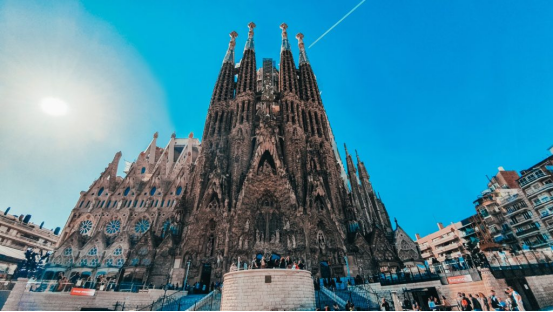
The Basilica i Temple Expiatori de la Sagrada Família, a replica of a supersized sandcastle, is one of the most striking works by Barcelona, Spain, architect Antoni Gaudí. Gaudí’s idea was that architecture could be built like a sculpture, which led to the design of this beautiful cathedral.
143 Years of Construction
Construction of the building began in 1882 and remains unfinished. Gaudí dedicated the last 44 years of his life to its unique design. Knowing he would not see it completed, he left detailed drawings and plaster models, dividing construction into stages to allow subsequent architects to add their personal styles.
Gaudí died in a car accident in 1926, with only a quarter of the cathedral completed. Construction continued but was interrupted during the Spanish Civil War in 1936. Gaudí’s models and drawings were destroyed, slowing progress. It is expected to be completed in 2026, the 100th anniversary of Gaudí’s death, under the supervision of architect Mark Burry.
The construction of the Sagrada Família will even exceed the duration of the Egyptian pyramids, still renowned for their long construction time.
Design of this Dynamic Building
Gaudí hoped to spread the history of Catholicism through this building, evident in his design. The building exhibits elements of Gothic and Art Nouveau styles. Deeply inspired by nature, his philosophy was to abandon straight lines and sharp angles, as they appeared unnatural. He also believed the church would be built for and by the people.
Planning and Structure
Gaudí’s cathedral design, inspired by nature, features an organic architectural style that sets it apart from other churches. The church follows a Latin cross plan, a common feature of Gothic churches, but its uniqueness lies in the roofed passageway surrounding it, forming a rectangle.
The building uses a double-layer stone dome design to enhance durability. Innovative corner columns and hyperbolic vaults eliminate the need for flying buttresses, with building loads supported by internal columns, maintaining a simple facade.
Spires
Unlike other churches, Gaudí’s spires have specific meanings. Originally planned to have 18, only 8 were completed by 2010. Twelve smaller spires represent the Twelve Apostles, arranged in increasing height. The central spire of Jesus Christ is the tallest, topped with a huge cross. Two spires can be climbed to enjoy views of the building.
Facades
The church has three facades: the Nativity Façade in the east, the Passion Façade in the west, and the Glory Façade in the south.
- The three porches are separated by two columns on one side of the church, with a tortoise and a sea turtle at the base of the columns. These animals represent land and sea, symbols of time and the perfection of God’s creation.
- The Nativity Façade, the only one completed under Gaudí’s supervision, is both attractive and accessible, showcasing the building structure. It depicts the birth of Jesus through carvings and sculptures, with figures’ faces based on the death masks of Barcelona’s deceased, embodying Gaudí’s idea of making the people part of the church.
- The Passion Façade depicts the death of Christ. Compared to the Nativity Façade, it is simple and austere, with fewer sculptures but various scenes depicting the Resurrection.
- The Glory Façade, the largest, began construction in 2002. It represents the path to God, depicting scenes such as hell, purgatory, the Seven Deadly Sins, and the Seven Virtues.
The current design or existing building is a reconstruction of Antoni Gaudí’s original design.
Magic Square
The Passion Façade of the Sagrada Família features a 4×4 magic square composed of 16 numbers. It is said that the sum of the numbers in each row or column equals 33, the age at which Jesus was crucified. Some say the number 33 is related to Gaudí’s Masonic background. When designing this mysterious magic square (part of the church), Gaudí left behind much speculation and conspiracy theories for future generations.
Height
The church stands at 170 meters, making it the tallest place of worship in Europe. The architect’s concept was that the church should not exceed the height of Montjuïc, the tallest mountain in Barcelona. This idea stemmed from his belief that no building should surpass God’s creation.
Materials
As the Sagrada Família was built, Gaudí became one of the pioneers in Spain to use steel and concrete in building structures. Stone is also widely used in this magnificent building. Due to the construction spanning six generations, there are significant differences in the types of materials used.
The Sacred Interior
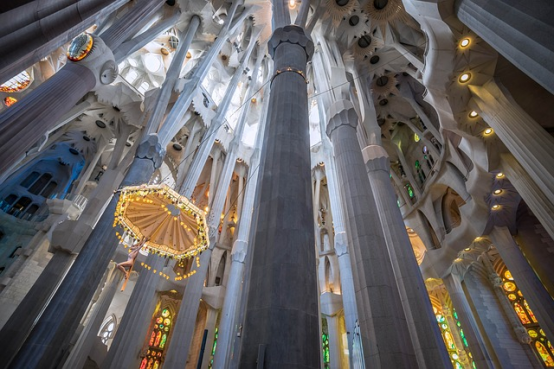
The church’s interior is as striking as its exterior, featuring colorful decorations, abundant light, and a lively atmosphere. Stepping inside, it feels like a colorful forest of stone. The interior also depicts natural scenes, with columns resembling trees and many hidden creatures. Let’s discuss the notable features of the cathedral’s interior.
- The most beautiful columns in the church not only bear weight but also create a wonderful interweaving of geometric shapes, giving the impression of being in a forest rather than a church.
- Stained glass windows introduce colorful light, making the space shine.
- A circular window projects a beam of sunlight, focusing on the statue of Christ.
- The iron railings of balconies and stairs are also exquisitely decorated.
- Mosaics on the roof reflect moonlight, transforming it into a lighthouse intended to guide sailors home.
- The cathedral contains a tomb where the remains of architect Antoni Gaudí are buried.
- Twelve bells on the spires can be heard inside the church, bringing a sense of joy.
When completed, the Sagrada Família will be a masterpiece. Its beauty lies in the details, with every part exuding refinement. The building demonstrates Gaudí’s vision of integrating nature and religion, with a bold style that has become a world-renowned architectural and urban symbol. Although unfinished, there is much to admire, and the final result is highly anticipated.